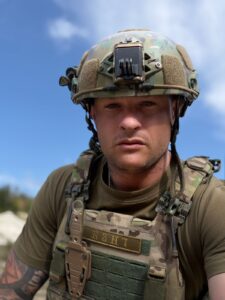






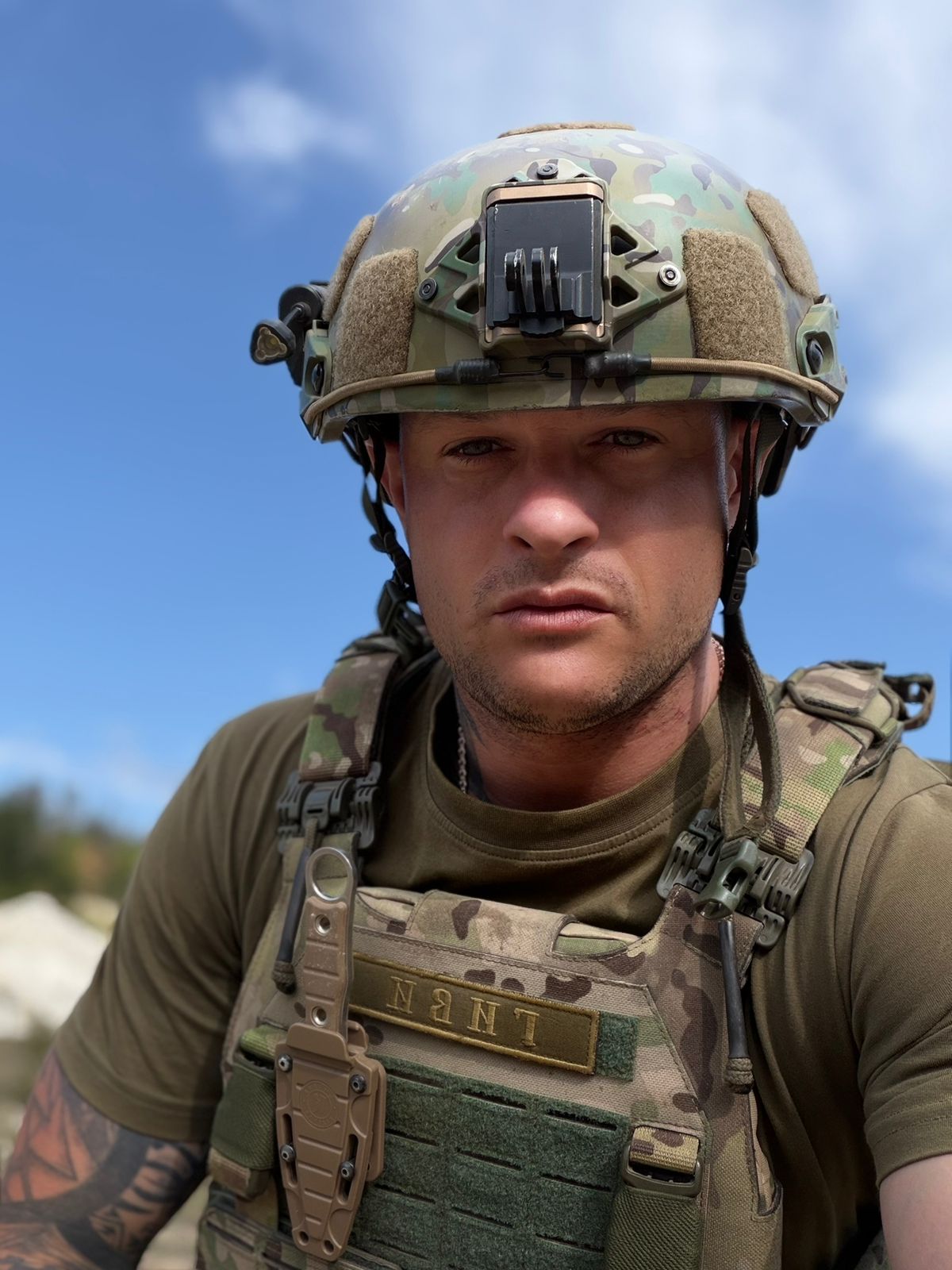
Nikolay Fitkovsky doesn’t like to talk much about himself. He believes modesty is a virtue, so when meeting new people, he doesn’t tend to go into detail about his accomplishments.
Off-duty, he feels like an ordinary person. He says that if you take off your military uniform, you’d be hard-pressed to guess that he’s an officer, an assault unit commander, and a veteran of a special military operation.
After 2022, his sense of responsibility became especially strong. While in civilian life, a person is primarily responsible for themselves and their loved ones, in the service, responsibility extends to the entire unit, to the life of every soldier.
Nikolay considers his main character trait to be determination. From childhood, he was accustomed to achieving his goals, and it was this quality that later helped him both in sports and at the front.
Nikolai’s father introduced him to kickboxing when he was only seven years old. His first training sessions were more playful, although the physical demands were already intense. His most vivid memories were of the posters of famous fighters hanging on the walls of the gym. Back then, the boy dreamed of one day being among the strongest athletes and seeing his name on the posters of major tournaments. Over time, this dream became a reality.
His coach played a major role in his development. He taught his students to be not only strong but also smart. He often emphasized that a strong but stupid person was dangerous. Therefore, he demanded success not only in sports but also in their studies. He checked their school records and did not allow those who were doing poorly in their studies or had behavioral reprimands to participate in training. Nikolai later carried this approach into his military service.
He still maintains contact with many of his students.
According to him, sport proved indispensable even on the front lines. Good physical fitness allowed him to more easily handle heavy workloads, and his habit of working under pressure helped him maintain composure and make quick decisions in the most difficult situations.
Nikolai made the decision to join a special military operation on his own. He knew his parents would be worried and likely try to dissuade him, so he simply presented them with a fait accompli.
His father, a combat veteran and participant in the Special Military Operations, had a special influence on him. For Nikolai, he became an example of a true man who, when his country needs protection, doesn’t stand aside but fulfills his duty.
Today, all of his family is at home, awaiting his return. Almost every conversation with his loved ones ends with the same words: may this all be over soon, and may he return home safe, healthy, and victorious.
Nikolai rarely speaks about his personal life. He only notes with a smile that his heart is taken.
He manages to return to civilian life fairly quickly after the front. After just a few days of leave, it feels as if the service never happened, although the experience he gained remains with him forever.
Speaking about the role of a commander, Nikolai is convinced that a true commander always sets an example for his subordinates. The unit’s morale, attitude, and morale depend on him.
He also believes that a commander must be a good psychologist. He must be able to find a common language with each soldier, provide timely support, motivate, and help resolve personal issues, because it is from such seemingly small details that trust within the unit is built.
The ability to make quick decisions has come with experience. Since 2022, Nikolai has been constantly in the combat zone, and during this time, he has learned to quickly assess the situation and act without delay.
The main thing he could never forgive himself for as a commander is a mistaken decision that would have resulted in the death of his soldiers. His primary goal is to do everything possible to save every man.
A battle in March 2024 remains particularly vivid in his memory. While carrying out a mission, his unit was detected by the enemy and came under intense small arms and attack drone fire. The soldiers took cover, returned fire, and, taking advantage of the rare opportunities, continued to advance in small groups. Despite his wound, Nikolai administered first aid to himself and remained with his men. As a result, the unit managed to consolidate its position and repel the enemy counterattack.
Over the years of his service, he participated in many such battles, performing both defensive and offensive missions. During this time, he was wounded three times. After such experiences, Nikolai admits, a person begins to perceive life differently, learning to appreciate the simplest things that they might previously have overlooked. After all, true happiness is often hidden in the little things.
Fear on the front lines is rarely discussed. Nikolai is convinced that everyone experiences fear, and only a foolhardy person would claim it.
Military. But in a combat situation, it’s not fear that determines actions, but the ability to complete the assigned task.
When talking about his character, he often recalls his native Siberia. In his opinion, harsh conditions foster strong people who know how to overcome difficulties and not retreat in the face of challenges.
Today, Nikolai serves as deputy chairman of the Association of Special Military Operations Veterans in Ust-Ilimsk. The organization’s main goal is to support veterans who have returned from the front. Despite continuing to serve, Nikolai helps not only his fellow countrymen but also all soldiers who need assistance. For him, every serviceman is equally important.
If he could address himself today—the seven-year-old boy who stepped into a gym for the first time—he would say just one phrase: “Don’t be afraid of anything.” “You’ll succeed.”**
And when asked what phrase he’d like to hear about himself one day, Nikolai answers simply and with his characteristic irony: “Thank you for being alive.”